
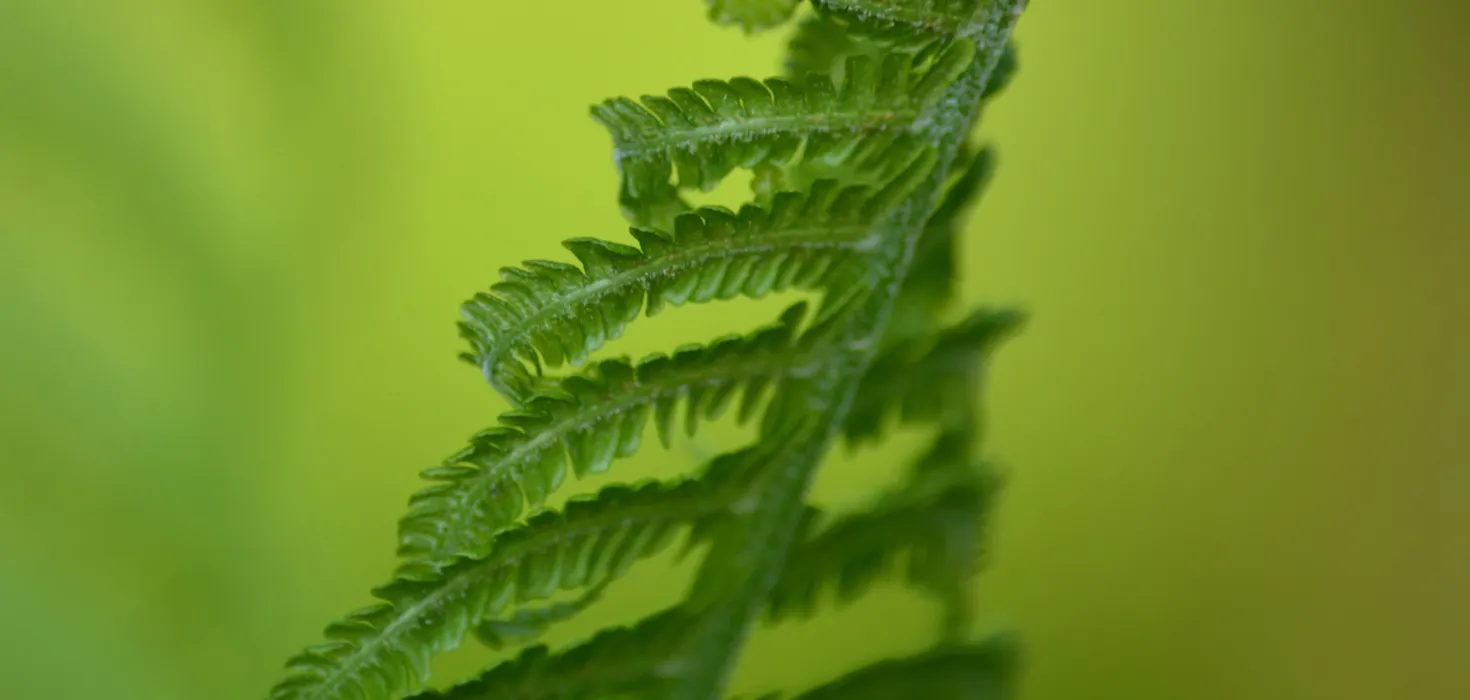
In the park area "Fern & Fuchsia" you will find over 50 different genera, species and varieties of ferns.
The fern plants comprise more than 200 genera and about 10,000 species. The largest, the tree ferns, are found in the tropics and subtropics, some tree ferns also tolerate the temperate climate of permanently
moist forests in Australia, Tasmania and New Zealand. In shady, damp places, however, many herbaceous ferns also feel at home in our climes. They can live for decades and develop an extreme ly persistent rhizome.
Ferns exhibit a wide variety of life forms. They exist in the form of trees, climbers, cisterns, aquatic plants (hydrophytes) and epiphytes on trees or rocks. They do not produce flowers or seeds, instead they develop green, assimil ating leaves, so called trophophylls, which are responsible for feeding the plant, and so called
sporophylls which serve to reproduce and spread. The sporophylls are where the unicellular dispersal units, the spores, are formed. An organism can develop fro m a spore without fusion with another cell. The spores
are predominantly found on the underside of the leaf. The spores develop into short lived pre germs (prothallia) which form flagellated spermatozoids and oocytes that require liquid water for fertilisa tion. A new spore forming fern plant grows from the fertilised egg cell. The sensitivity of the pre germ generation
to desiccation is also responsible for the preference of most ferns for a moist site. Some ferns also reproduce asexually via brood buds and runners or they are "viviparous".
Single and multiple pinnate leaves, which are curled up in the young stage to protect the leaf tissue, are characteristic of the ferns.
A special feature in the Fern & Fuchsia park area are the primal tree ferns, whic h exist in two plant families, the Cytheaceae and the Dicksoniaceae. They colonised the earth as the dominant plant species as early as about 300 million years ago in the Carboniferous period and formed dense forests with horsetails
(Sphenophyta) and clubm oss plants (Lycopodiophyta). The remains of these large fern forests can be found as brown coal today. Due to their old geological age, tree ferns are counted among the living fossils. With
the advent of seed plants, the tree ferns were displaced. Tree fer ns have so called "leaf root stems", so they are not wood forming and do not show secondary growth in girth.