
Prehistory and early history
Remains of pile-dwelling settlements found around the shores of Lake Constance suggest that the island of Mainau was inhabited early on. A settlement consisting of six houses was uncovered on the southern shore of the island and dated to the Neolithic period. Around 400 BC, the island was probably part of the Celtic settlement area. However, no traces of such settlements have yet been found.
From 15 BC, the Lake Constance region belonged to the Roman province of Raetia. Although there is no evidence of remains, it is assumed that Mainau was used as a naval base in this context. Roman rule on Lake Constance came to an end around the year 400. The Romans were followed by the Alemanni. In the 5th and 6th centuries, the island of Mainau was an Alemannic ducal estate, later part of a Frankish royal estate administered from Bodman.
In 724, the wandering bishop Pirmin founded a Benedictine monastery on the largest island in Lake Constance, the island of Reichenau, which developed into a spiritual center of the West in the centuries that followed. Soon after its foundation, the Reichenau monastery received other settlements on the mainland opposite the island as donations. The island of Mainau probably also went to Reichenau Monastery in this way in 724. Ministerials settled on Mainau as administrators, who probably also built a castle on the island, first mentioned in 1272. Traces of an extensive fortification system can still be seen in the southern part of the castle today. From the 13th century onwards, Reichenau Monastery became increasingly less important, which ultimately led to the ministerial Arnold von Langenstein donating Mainau and other land on the mainland to the Teutonic Order in 1271. In return, the Order accepted two of his sons.
The Teutonic Order on Mainau
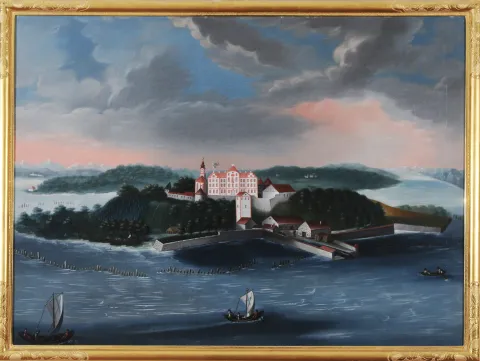
The time of the Teutonic Order is an important milestone in the long history of the island of Mainau. A time whose traces are still clearly visible today, especially in the striking baroque building complex of the castle and church. The commanders of the clerical order of knights founded at the time of the Crusades ruled the island as administrators of this branch of the order until 1806, i.e. for over 500 years. After the donation, however, Mainau and the associated land on the mainland initially went to the branch of the Teutonic Order at Sandegg Castle near Salenstein in the neighboring Swiss canton of Thurgau. In 1272, the Sandegg commandery was dissolved and relocated to Mainau. There, the castle complex was expanded and the acquisition of goods by the Teutonic Order was extended to the north, so that the Kommende Mainau eventually developed into the wealthiest branch of the Order's province of Alsace-Burgundy.
During the Thirty Years' War (1618 - 48), the Swedes also took control of Mainau for two years. Although the island was initially considered a safe haven, Swedish troops managed to take it over in 1647. It was only in the final phase of the war that Mainau was fortified with a closed entrenchment system, of which only a few remains are still visible today.
After the Peace of Westphalia in 1649, the Swedes left, not without having devastated and plundered the island. Only the so-called "Swedish Cross" is said to have been too heavy for them, which is why, according to legend, they left the crucifixion group, probably cast in bronze in Constance in 1577, lying in the shallow water between the island and the mainland. It was later erected there and today greets visitors to Mainau as the "Swedish Cross".
The order's Mainau commune was slow to recover from the consequences of the war. However, the fact that the Provincial Superior of the Province of Alsace-Burgundy granted permission to build a new church on the island may be seen as the dawn of a new era. The contract was awarded to the master builder Johann Caspar Bagnato (1696-1757), who began construction of the baroque church in 1732. In 1739, the castle church was consecrated to the Virgin Mary and in the same year, Bagnato was also commissioned to build a castle on the island. The castle, previously used as the seat of the commander, was demolished for the new buildings. After seven years of construction, the castle of the Teutonic Order was completed in 1746. The magnificent coats of arms on the gables of the central wing still remind us of the builders today.
In the course of secularization, the Deutschordenskommende Mainau was dissolved in 1806 and all its possessions became part of the newly founded Grand Duchy of Baden.
19th century
With the end of the Teutonic Knights on Mainau, the island entered a period of almost 50 years of uncertainty and decline with many changes of ownership. The reigning Grand Duke Karl Friedrich had little interest in the small island in Lake Constance during the Napoleonic Wars. From 1811 to 1818, he was succeeded by his grandson Karl Ludwig Friedrich, who was equally unenthusiastic about Mainau.
His successor, Grand Duke Ludwig von Baden, finally sold the island to the Hungarian Prince Nikolaus von Esterházy for 65,000 guilders in 1827, who had the first exotic plants planted on the island, including a fig trellis on the palace façade that still exists today. Three years later, Prince Esterházy bequeathed Mainau to his illegitimate son Nikolaus, whom the Grand Duke had previously elevated to Baron of Mainau. Without having shown much commitment to the island, he sold Mainau to Countess Katharina von Langenstein after 9 years, which meant that the island once again became the property of the von Langenstein family, who had donated it to the Teutonic Order in 1271, after more than 500 years. Another 9 years later, Countess von Langenstein sold the island to her daughter Louise, who had married the Swedish Count Douglas. The couple soon wanted to sell the island again and finally found a buyer in 1853 in Grand Duke Friedrich I von Baden, great-grandfather of Lennart Bernadotte.
Today, the Grand Duke of Baden is regarded as the founder of the park. He not only established his summer residence here, but also began to create order on the island, redesigning it and planting rare exotic trees and plants that he brought back from his travels. Key elements of Mainau Park, such as the arboretum, Italian rose garden and orangery, date back to this time, as do the first winter shelters for exotic plants and the first iron bridge as a link to the mainland.
The history of the island in the 20th century
After the death of Grand Duke Frederick I in 1907, Mainau passed to his son, Grand Duke Frederick II. He bequeathed the island to his sister Victoria, Queen of Sweden, which meant that Mainau became the property of the Swedish royal family in 1928. After Queen Victoria's death, the island passed to her son Prince William of Sweden in 1930, who transferred the administration of this inheritance to his then 23-year-old son Lennart in 1932. In the same year, Lennart Bernadotte retired from Sweden to Mainau after losing all titles and hereditary claims to the Swedish royal family through his marriage to the commoner Karin Nissvandt, and made the island his new home for himself and his family. Lennart Bernadotte began to gradually transform the neglected island back into a park at great expense and soon opened Mainau to visitors, for whom the "Schwedenschenke" restaurant was opened in 1937. In the years leading up to the Second World War, Mainau benefited considerably from the state-run "Strength through Joy" tours, which brought thousands of visitors to the island.
War and post-war period
Lennart Bernadotte left the island before the start of the war in 1939. He spent the time until the end of the Second World War with his family in Sweden. The buildings, park, gardens and visitors to Mainau were looked after by a couple who were able to look after the grounds and operations until the caretaker was called up to the Wehrmacht in 1942. In this situation, Prince William of Sweden and his son Lennart Bernadotte decided with a heavy heart to comply with a request from the Todt organization. The construction organization of the Ministry of Armaments wanted to lease Mainau for the duration of the war and set up a recreation home for officers and industrialists there. The lease agreement was concluded and from mid-1943 Mainau was administered by the Todt organization. The recreation home was to be set up in the castle and archway building, and three additional wooden barracks were built to accommodate the staff. A water pipe was also laid from the Egg district of Constance to the island. So everything was ready, but high-ranking members of the Todt organization no longer had the opportunity to recuperate on Mainau.
Instead, shortly before the end of the war, the Foreign Office assigned the island to French collaborators, who gathered around the leader of the radical right-wing "Parti Populaire Français" (PPF), Jacques Doriot. From southern Germany, the group planned to drive the Gaullists and Communists out of France, for which Doriot proclaimed a French Liberation Committee on the island of Mainau in early 1945. However, this Franco-German collaboration came to an end in February 1945 when Doriot was killed in a low-flying air raid near Mengen. As a result, his followers fled Mainau.
April 26, 1945 marked the beginning of a new era for Constance and the surrounding area: the region became part of the French occupation zone. The islands of Mainau and Reichenau were evacuated in mid-May 1945. The islands were chosen for the accommodation and recuperation of French prisoners liberated from Dachau concentration camp. In total, several thousand prisoners were brought to Lake Constance, most of them to Reichenau. On Mainau, the castle and the barracks built by the Organization Todt were now empty. They now served as accommodation, primarily for seriously ill and particularly weakened former concentration camp prisoners, who were treated, cared for and looked after by French doctors and French and German nurses according to the latest standards. But for 34 of them, all help came too late. Despite good care, they died during their stay on Mainau and were initially buried on the eastern shore of the island in a makeshift burial ground. After his first visit to the island after the end of the war, Lennart Bernadotte arranged for the dead to be reburied in the main cemetery in Constance. The remains were then transferred to France between 1947 and 1949. A memorial was erected in November 2012 in memory of the 34 former prisoners of the Dachau Nazi concentration camp.
The military hospital on Mainau was dissolved in September 1945 and the former concentration camp prisoners who had regained their strength were taken to France. The French occupying troops also eventually left Mainau again. When Lennart Bernadotte returned to the island for the first time in January 1946, he reported that he found the grounds in a state of disrepair and the castle largely empty. The settlement of the damage and the replacement of the missing furnishings led to a lengthy dispute with French administrative authorities. The reconstruction and repair work in the park and gardens proved difficult, but Mainau was soon reopened to visitors.
In order to open a "window to the world" for young people after the destruction of the war, Lennart Bernadotte offered meetings and camps for young people on Mainau as early as 1946 as part of the Young Men's Christian Association (CVJM) - now the Young Men's Christian Association - under Swedish management. The participants were initially accommodated in barracks built by the Todt organization, which were demolished in 1951. During these difficult post-war years, some of the supplies came from Sweden and Switzerland. The aim was to enable war-damaged young people to relax and meet young people from other countries.
This institution developed into the "International Institute Schloss Mainau", which began operating in a wing of the castle in 1949 under the sponsorship of the YMCA World Federation and offered courses, seminars and workshops on a wide range of youth issues. By the time the institute closed at the end of 1968, around 20,000 participants from 40 countries had attended the events at Mainau Castle.
History of the garden
Old plans show that the island of Mainau was also used for horticultural purposes early on. By the time of the Teutonic Order at the latest, ornamental and kitchen gardens were laid out on the island around the palace complex, while the shore area was used for agriculture. The oldest remaining trees, the lime trees on the east side of the island, also date back to this time. The first gardens were created at the beginning of the 19th century under Prince Esterhazy, who planted the first exotic trees and rare plants on the island. However, Grand Duke Friedrich I of Baden was decisive for the further development of Mainau as a paradise of flowers and plants. From 1853 until his death in 1907, he and his court gardeners developed and gradually implemented an overall concept for the development of the island with paths, avenues and viewing areas. In doing so, he laid the foundations for Mainau's current design. The park in the interior of the island, the arboretum with its now 100 to 150-year-old trees, was also created during the time of Frederick I, who brought back numerous exotic trees and shrubs from his travels. The Italian Rose Garden on the south side of the palace also dates back to the time of the Grand Duke, who had an Italian-style flower garden laid out here in 1860.
Wine was already being grown on Mainau at the time of the Teutonic Order, although the vineyard planted on the south-western slope of the island near the so-called Swedish Tower dates back to Frederick I. At that time, the vineyard walls were built, the soil was replaced and experiments were carried out with grape varieties. Excellent Lake Constance wine still thrives here today. The educational wine trail provides information about the history and development of viticulture on Lake Constance and on Mainau in particular.
After the death of Frederick I, nothing was allowed to be changed in the park and gardens at the request of his widow. Lennart Bernadotte therefore took over a park overgrown with native vegetation in 1932, in which initially more had to be cleared than planted. Based on the foundations laid by Frederick I, Lennart Bernadotte gradually developed today's "Flower Island Mainau", his life's work.
First, the valuable arboretum was cleared of wild growth and the lines of sight were cleared - it was no easy task to decide which tree to cut down, but after all, on an island you should always have a view of the water. He first photographed a section of the park, then retouched trees to make them easier to see in the photos and only then cut them down. In this way, the basic structures of the original park were first restored and then further landscaping began. From 1950 onwards, the development into a flower island progressed in great strides. 1955 was already a "real" Mainau flower year with an orchid show, spring alternating flora, rhododendrons, roses, summer alternating flora, citrus collection, fuchsia collection and dahlias. The historic buildings, including the castle and castle church, were gradually renovated inside and out. In 1968, a large palm house was built to replace the previous winter shelter houses. Last but not least, the necessary island infrastructure had to be created: a Lake Constance water pumping station to irrigate the park, a sewage system through the lake bed, telephone lines and roads. The park and tourist infrastructure were developed according to need and demand. There was no general plan, which distinguishes the island of Mainau from many other parks.
Today, Mainau's park and gardens attract around 1 million visitors every year. 25 hectares of the 45-hectare island are now a show area. And the park is being continuously developed. In 2003, the entire island of Mainau was placed under monument protection and part of the island was entered in the register of monuments as a "cultural monument of special significance". The castle, castle church, harbor, Italian rose garden, parts of the arboretum and all of the historic fortification walls are listed at the highest level of protection. The sensitive further development of the island by the Bernadotte family in dialog with the relevant authorities is based on monument protection and additional protection categories of nature conservation.
Further reading
- Blumeninsel Mainau GmbH: „Kreuz und Schwert“, Ausstellungskatalog 1991
- Blumeninsel Mainau GmbH: „Lennart Bernadotte“, Ausstellungskatalog 1992
Burchardt, Lothar; Engelsing, Tobias; Klöckler, Jürgen: „Gutachten – Lennart Bernadotte (1909-2004) während der Zeit des Nationalsozialismus und in den unmittelbaren Nachkriegsjahren“. 2014;
ergänzend dazu: Aufsatz von Klöckler, Jürgen in: "Schriften des Vereins für Geschichte des Bodensees und seiner Umgebung". Jan Thorbecke Verlag, 2014
download the essay for further reading
- Dées de Sterio, Alexander und Johanna: „Die Mainau – Chronik eines Paradieses“. Belser Verlag Stuttgart, 1977
- Graf Bernadotte, Lennart: „Ein Mann Eine Insel Ein Lebenswerk“. Blumeninsel Mainau GmbH, 1992
- Graf Bernadotte, Lennart: „...ein Leben für die Mainau“. Stadler Verlag, 1996
- Graf Bernadotte, Lennart: „Gute Nacht kleiner Prinz“. Heyne Verlag München, 1987
- John, Timo: „Eine Familie aus Schweden auf der Bodenseeinsel Mainau“. Kunstverlag Josef Fink, 2009
- Burchardt, Lothar: „Stadtgeschichte Konstanz“, Band 4
- Moser, Arnulf: „Die andere Mainau“, Universitätsverlag Konstanz, 1995
- Orlik, Roger: »…Der König vom Bodensee«, Albstadt: SP Verlag 2002
- Pfindel, Judith; Meier, Heinz-Dieter: „Die Pflanzenwelt der Mainau“. Hampp Verlag, 2005
- Wendt, Gunna: „Die Bernadottes und die Romanoffs“. Huber Verlag Frauenfeld, 2009
- Wendt, Gunna: „Gräfin Sonja Bernadotte“. Droste Verlag Düsseldorf, 2010